Every founder is told to build a moat. Few are warned that the first one they dig, their own name, is also the one that empties the moment they step back. The cheapest attention a young company can buy is the hardest asset it will ever try to keep.
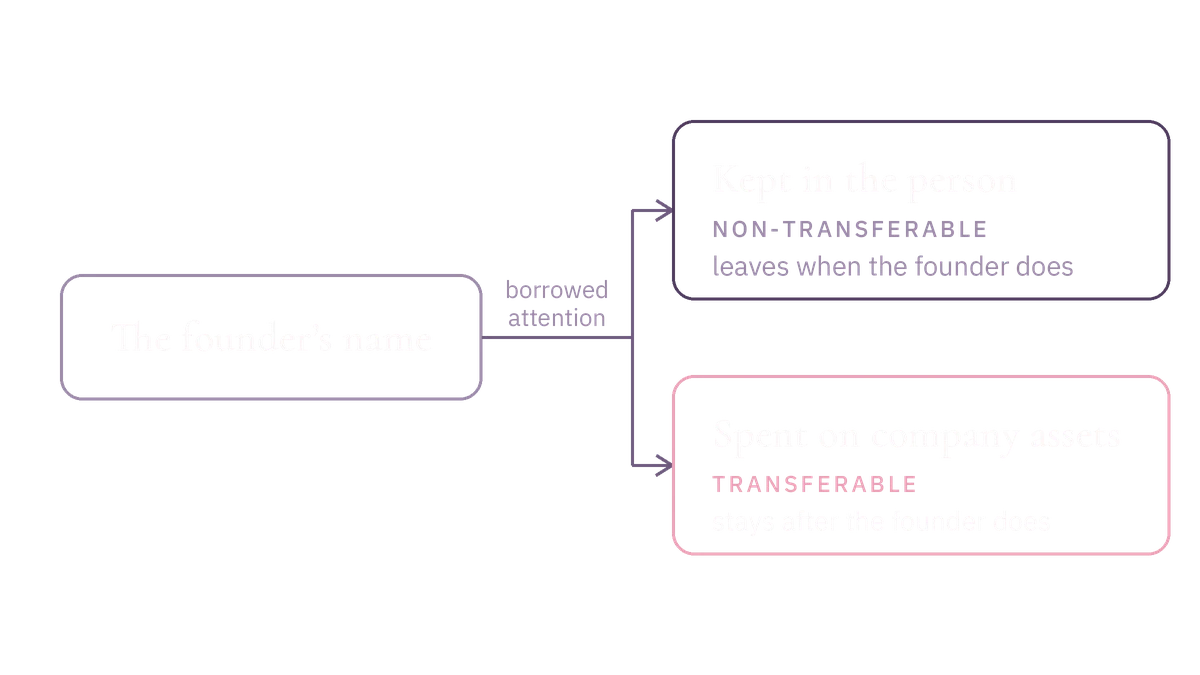
There is a moment, usually early, when the founder becomes the fastest way to explain the company. The face does the work a media budget would otherwise have to buy. People trust the person, follow the person, buy because of the person, and the business grows on borrowed warmth that costs almost nothing. It looks like the smartest marketing decision anyone has ever made, and for a while it is. The question almost no one asks in that moment is the only one that matters later: who actually owns the trust.
Martha Stewart learned this in public. She had built Martha Stewart Living Omnimedia into a company whose every asset, the magazine, the television, the product lines, ran on the credibility of her name. When she was convicted in 2004 and served time, the business did not lose a spokesperson. It lost its foundation, because there was no meaningful line between her reputation and its balance sheet, and the value fell with her. [verify: extent and timing of MSLO's decline through 2004 to 2005] The lesson was never that founders should hide. It was that a company built entirely on one person's standing has no shock absorber when that standing takes a hit, and every standing eventually takes one.
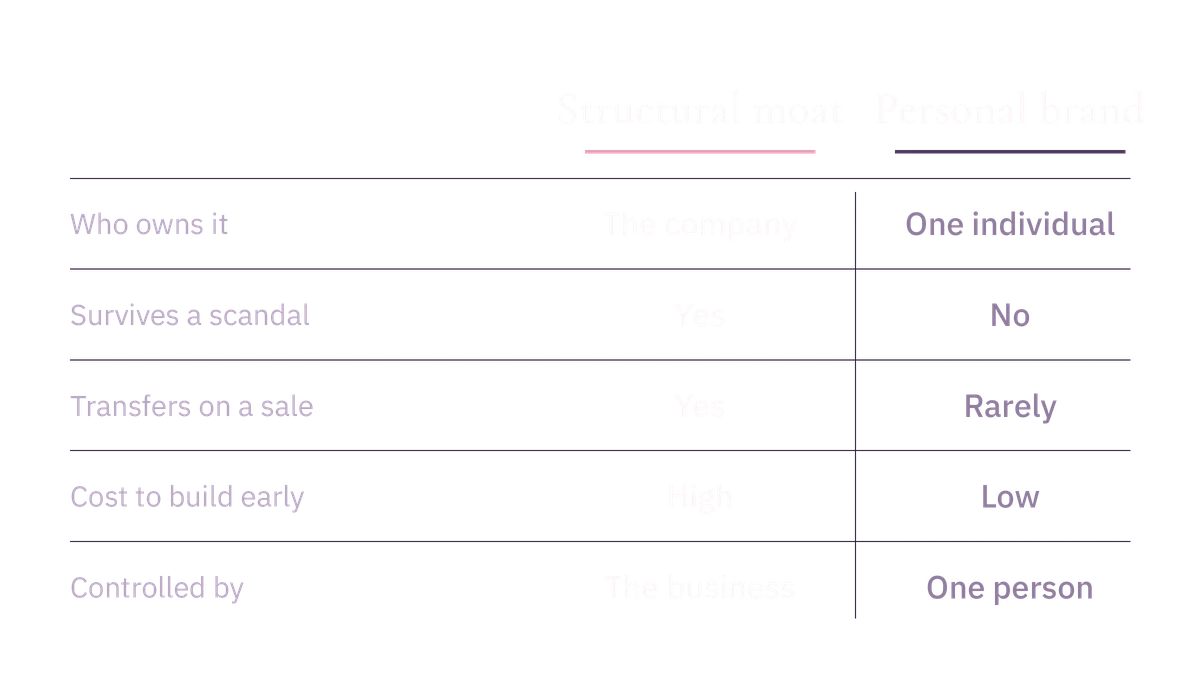
The trap is that the personal brand works, which is exactly what makes it dangerous. A strategy that fails announces itself. A strategy that succeeds while quietly making you irreplaceable feels like winning, right up until the day you want to raise, sell, step back, or simply be less present. Founders leaning on their own name rarely notice the dependency forming, because the graph keeps going up and to the right. The dependency is only visible from the exit, and by the time you are standing there it is expensive to unwind.
The founders who use this well treat the personal brand as scaffolding, not structure. Sara Blakely was the story of Spanx for years: the face, the origin myth, the reason a journalist would write about a pair of footless tights at all. But underneath the personal brand she was building a product brand, something with a name, a position, and a value that did not require her to keep performing it. When she sold a majority stake to Blackstone in 2021, she was selling a business, not a biography. The attention her name attracted was real. What mattered was what she built with it before the attention moved on.
So the work is not to suppress the founder. The founder is often the cheapest and best distribution a young company will ever have, and refusing to use it is its own kind of vanity. The work is to spend that attention rather than depend on it. Use the reach the name buys to build the things that outlast it: a brand with a position of its own, a team the market trusts by name, a product that would still make sense if the founder deleted every account tomorrow. Treat the personal brand as a bridge. Cross it. Do not move in.
Creators are racing to build detachable brands. The smarter creator businesses are converting personal attention into products that can stand alone, from Feastables to Chamberlain Coffee, precisely so the asset is not the person. The tell is a name on the shelf that no longer needs a face beside it to sell.
Buyers now price founder dependence as risk. In acquisitions, businesses whose goodwill sits in one person routinely attract earnouts, lock-ins, and lower multiples, because the value may walk out with the seller. Key-person risk used to be a footnote. It is increasingly the whole negotiation.
"Founder mode" is pulling against the market. Paul Graham's 2024 essay made founder-centric leadership aspirational again, just as acquirers grow warier of companies that cannot function without their founder. The culture is celebrating the very dependency the market has started to discount.
A founder who becomes the brand has agreed, without quite noticing, that the company will end when they do.

Your go-to newsletter for expert perspectives on digital marketing, branding, and storytelling.