
For a decade, the creative was the last thing a performance team worried about. Meta has quietly reversed that order.
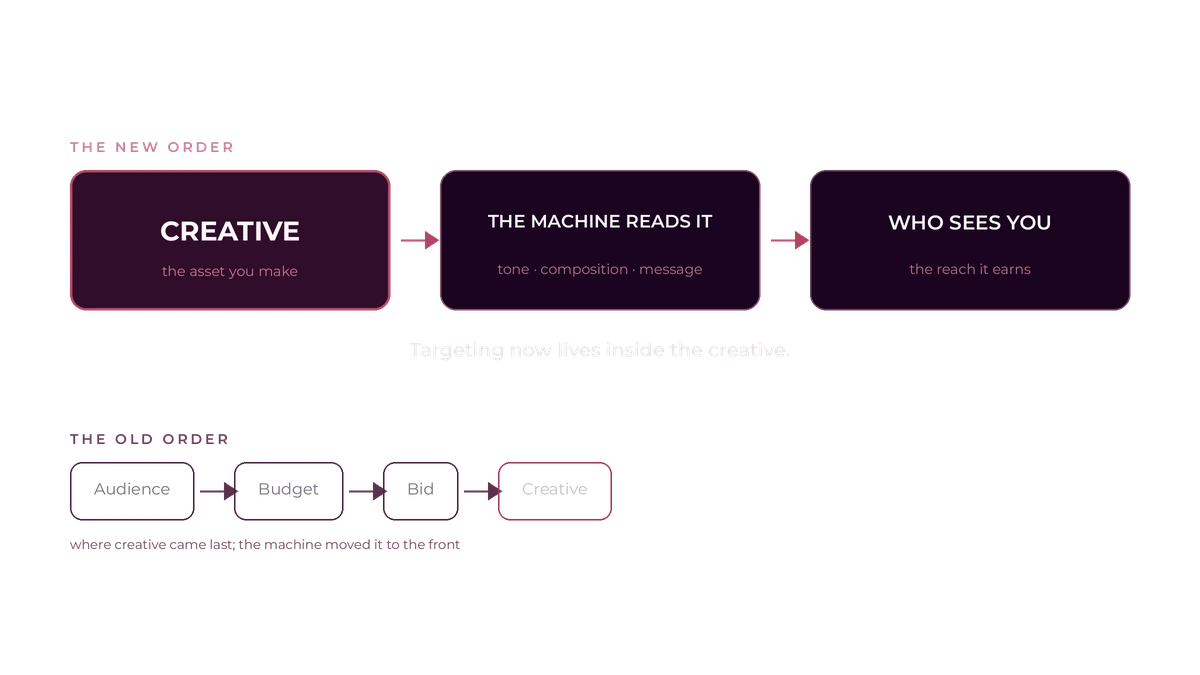
There was an order to things. You built the audience, set the budget, tuned the bids, and somewhere near the end someone dropped in the creative. The image was the last decision, and the least examined. It dressed the strategy; it did not make it.
Meta has dismantled that sequence. Andromeda, the AI retrieval engine that began rolling out across its platforms in 2025, no longer waits for the creative to arrive last. It reads the creative first. Tone, composition, pacing, the message itself: these are now the signals the system uses to decide who sees an ad, and how often. [verify: Andromeda introduced July 2025, global rollout October 2025.] The targeting did not disappear. It moved inside the creative. Which means the most consequential brand decision a company makes is no longer where it spends, but what it makes, and that decision has been handed back to the people who run and commission the work.
This should be good news. For years the discipline of brand and the discipline of performance argued past each other, one defending meaning, the other defending the number. Andromeda settles the argument in brand's favour by accident: the system rewards creative that is distinctive, coherent, and legible, because those are the qualities its models can read and match. A vague ad returns a vague signal. The machine, it turns out, has something like taste.
And here is where most brands have gone wrong. Told that the system feeds on variety, they have heard only the first word. The instruction "make many distinct creatives" has been read as "make a lot." So they flood the auction. Forty cuts of the same idea, a thousand variations stamped out by generative tools, each one slightly different and none of it about anything. They have answered a question about quality with a quantity.
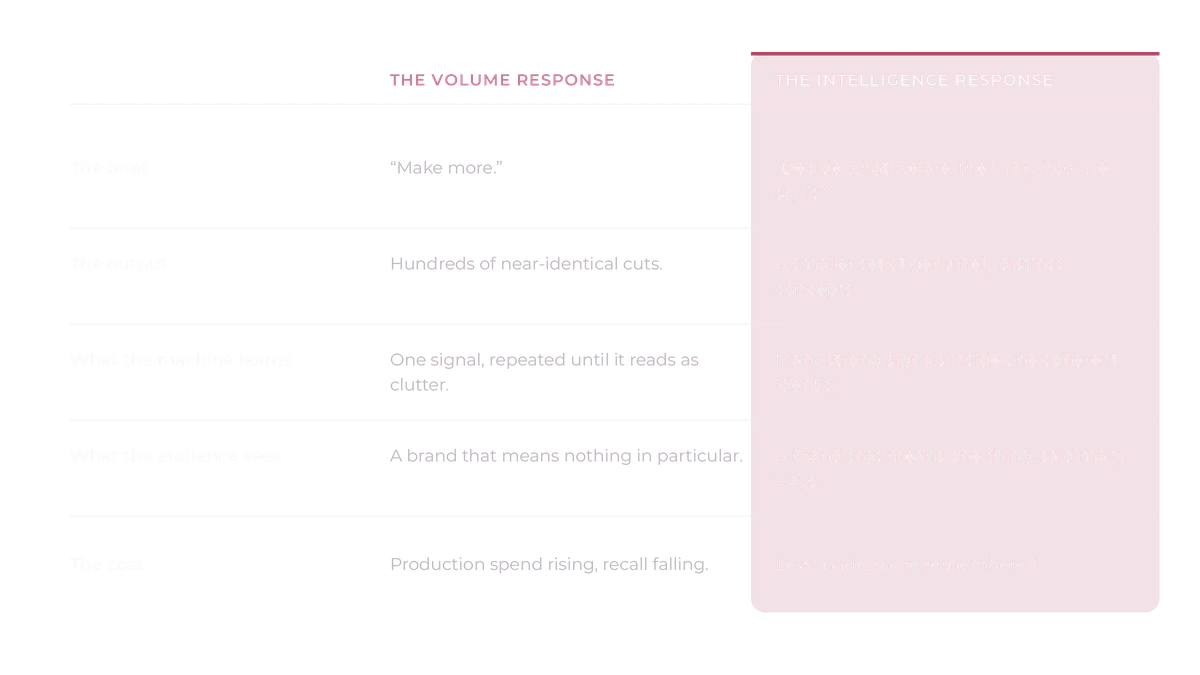
The volume response misunderstands what variety is for. Andromeda is not asking for more outputs; it is asking for more information. A testimonial, a product demonstration, a piece of dry humour, a quiet hero shot: these teach the system something, because each carries a different signal. Ninety renders of the same layout teach it nothing, and worse, the system has begun treating that sameness as redundancy to be suppressed rather than range to be rewarded. [verify] Volume, the thing brands reached for to feed the machine, is the one thing the machine has learned to ignore.
There is a deeper cost, and it is not paid in the auction. It is paid in the brand. Variety without a fixed identity is not range; it is incoherence, and incoherence is invisible to a model but ruinous to a market. A person does not see your forty cuts as forty signals. They see a brand that looks like everyone and stands for nothing. The machine's appetite for difference and the audience's need for consistency pull in opposite directions, and the brands that will win are the ones that hold both: many executions, one unmistakable identity. Range inside a discipline. That is not a media-buying skill. It is a brand decision, made upstream, by people with taste.
So the work returns to where it should have been. Decide what you are with enough conviction that the decision survives a hundred executions. Build a creative system, not a content quota, one that can speak in many registers without losing its voice. Then let the machine do what it now does well: carry distinctive work to the people most likely to respond to it. The brands that treat Andromeda as a printing press will keep paying more to be remembered less. The brands that treat it as a reader will give it something worth reading.
Andromeda moves targeting inside the creative. Meta's retrieval engine now reads creative attributes (tone, visual style, message) as primary relevance signals, completing its shift from audience-led to creative-led delivery. The practical effect: the asset is no longer the last decision in a campaign. It is the first, and the most consequential. [verify]
Generative tools made volume free, and therefore worthless. Meta's own AI ad-generation features let advertisers spin near-infinite variations at near-zero cost. The predictable result is a flood of interchangeable creative, and a system increasingly tuned to suppress sameness. Abundance has made distinctiveness the scarce input. [verify]
Brand and performance budgets are quietly merging. As creative quality becomes the lever that moves delivery, the old wall between the brand team that decides meaning and the performance team that buys reach is dissolving. The brief that once travelled downstream now sits at the centre. Who owns creative is becoming a structural question, not a turf one.
Volume is the sound a brand makes when it has run out of things to say.

Your go-to newsletter for expert perspectives on digital marketing, branding, and storytelling.


